

Planning ERCES, DAS, and Private 5G for performance, compliance, and long-term flexibility
A Market That Never Sits Still
Few sectors evolve as rapidly as communications infrastructure, yet the need for dependable execution has not changed. Across commercial, healthcare, education, public-sector, and mixed-use facilities, owners are making decisions about distributed antenna systems (DAS), emergency responder communication enhancement systems (ERCES), and private 5G while technology, code requirements, funding models, and stakeholder expectations shift at once.
For owners and development teams, the challenge is understanding how these systems affect occupancy, public safety, operations, tenant experience, and future flexibility.
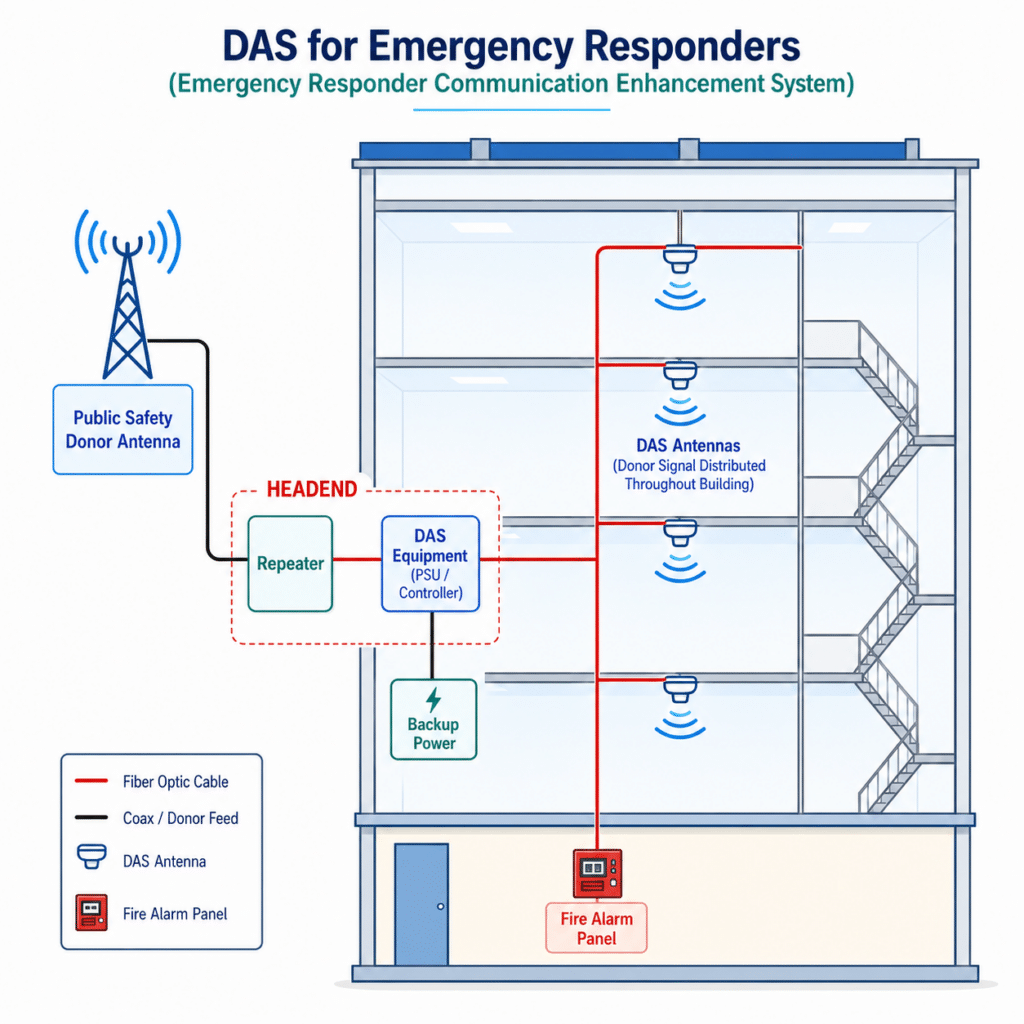
ERCES requirements are now tied to certificate-of-occupancy approvals in many jurisdictions, making public-safety radio coverage a life-safety priority rather than a specialty add-on. DAS projects, once commonly driven by carrier investment, are increasingly owner-funded and treated more like building utilities. Private 5G is also moving from concept to implementation, often alongside Wi-Fi, carrier networks, and traditional DAS infrastructure.
The Persistence of the Same Mistakes
That convergence creates opportunity. It also creates risk. Despite major technological advances, many projects still struggle with the same avoidable problems: unclear requirements, late coordination, incomplete RF modeling, value engineering that removes critical scope, and insufficient testing before turnover. These issues usually begin early, when objectives are not clearly defined and stakeholders are not aligned around measurable performance outcomes.
An AHJ may approve emergency radio coverage before the building is fully built out, an integrator may install exactly what was designed from an incomplete RF model, or a cellular DAS may proceed without proper carrier coordination. Each stakeholder may technically fulfill its role while the overall system quietly drifts away from operational success. By the time that drift becomes visible, ceilings are closed, schedules are slipping, and the cost of correction has multiplied.
A Less Forgiving Environment
The environment is becoming less forgiving. Tighter enforcement, higher accountability, and a more structured approach to planning, documentation, and inspection are changing how DAS, ERCES, and private wireless systems move from concept to occupancy. This evolving landscape of competing demands and disparate stakeholder requirements has elevated the wireless engineering consultant into a far more strategic role. Today’s engineer must operate as an inter-stakeholder translator, bridging the communication gap between owners, AHJs, wireless carriers, architects, contractors, integrators, and facility teams.
The Evolving Role of Consulting Engineering
This is where independent consulting engineering becomes critical. Owners need guidance that is not tied to a single product, vendor, or installation approach. They need a partner that can define the problem before prescribing the solution, establish performance criteria early, coordinate with AHJs, engage carriers and integrators at the right time, and keep the project focused on outcomes rather than assumptions.
We approach these systems as essential building infrastructure. That means asking practical questions at the beginning of a project:
- What code requirements apply?
- What user experience is expected?
- Which carriers or network operators must be involved?
- How will the system be tested?
- What documentation will be needed for approval, operations, and future modifications?
- What decisions made today could limit the building tomorrow?
Those questions matter because in-building wireless systems are rarely isolated. They intersect with architecture, electrical pathways, fire protection, security, IT networks, construction sequencing, tenant requirements, and regulatory approval. Without a coordinated plan, responsibility becomes fragmented among owners, carriers, AHJs, contractors, and vendors. Each party may be doing its part, but if no one is looking at the “bigger picture”, the operational intent of the system may still fail to be met.
Consulting engineering provides that continuity. From planning through design, procurement support, installation inspection, commissioning, and validation, an independent engineer maintains a clear line between the original requirements and the final system. That oversight is especially important when cost and schedule pressures intensify. Value engineering has a place, but it should not compromise the elements that make the system reliable, code-compliant, or adaptable.
Testing and documentation are equally important. A system should not be considered successful simply because equipment was installed or an inspection was completed. It should be verified against defined criteria, with results owners can understand and rely on. For public-safety systems, that discipline can have direct life-safety implications. For DAS and private wireless systems, it can affect tenant satisfaction, operational continuity, and the building’s ability to support future technologies.
Turning Complexity into Confidence
The next phase of DAS, ERCES, and private 5G will bring new possibilities, but better outcomes will not come from technology alone. They will come from disciplined planning, clear accountability, and engineering partners who understand both where the industry is going and where it has repeatedly fallen short.
For owners, developers, and facility leaders, the takeaway is straightforward: in-building wireless should be planned with the same seriousness as other critical building systems. When MSB Consulting Engineers is engaged early, clients gain more than a design. They gain a trusted technical navigator focused on reducing risk, aligning stakeholders, and delivering communications infrastructure that performs when it matters.